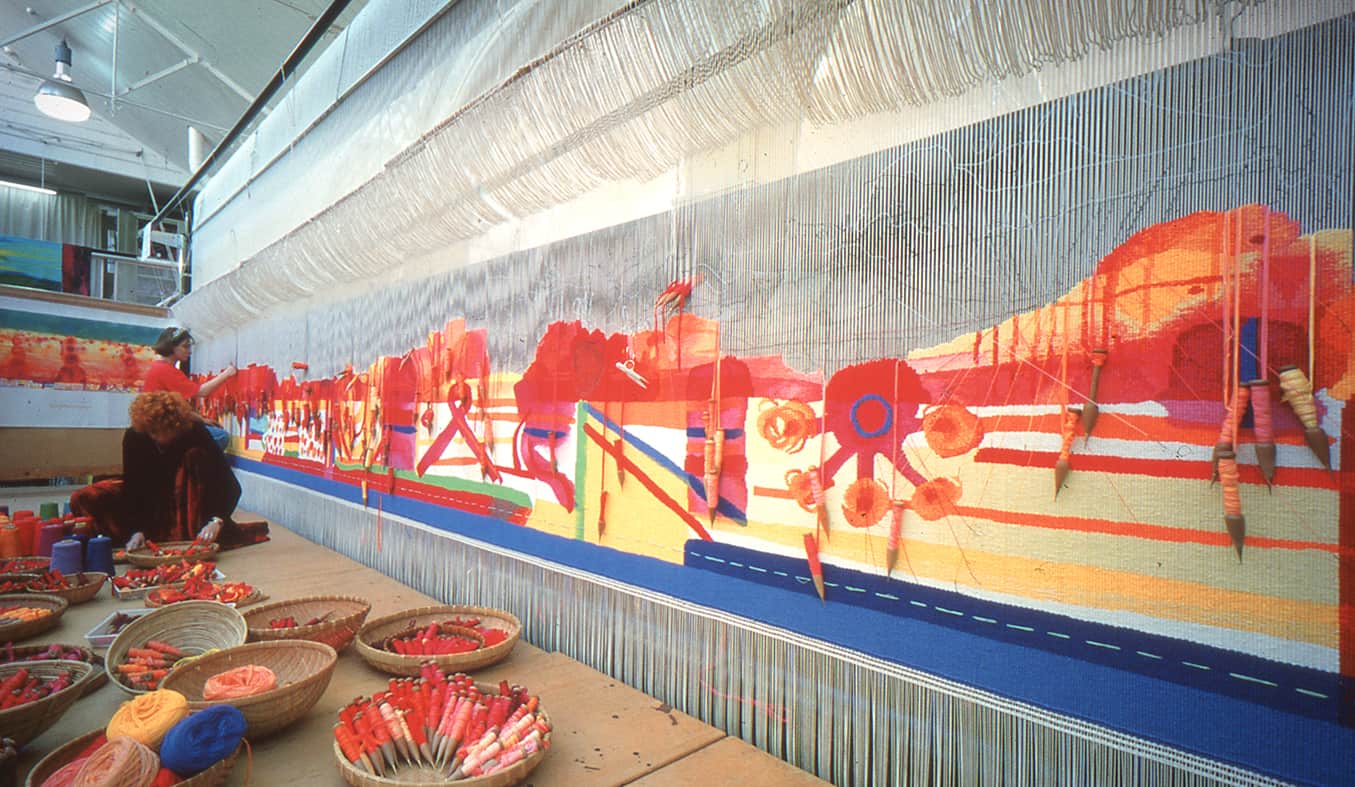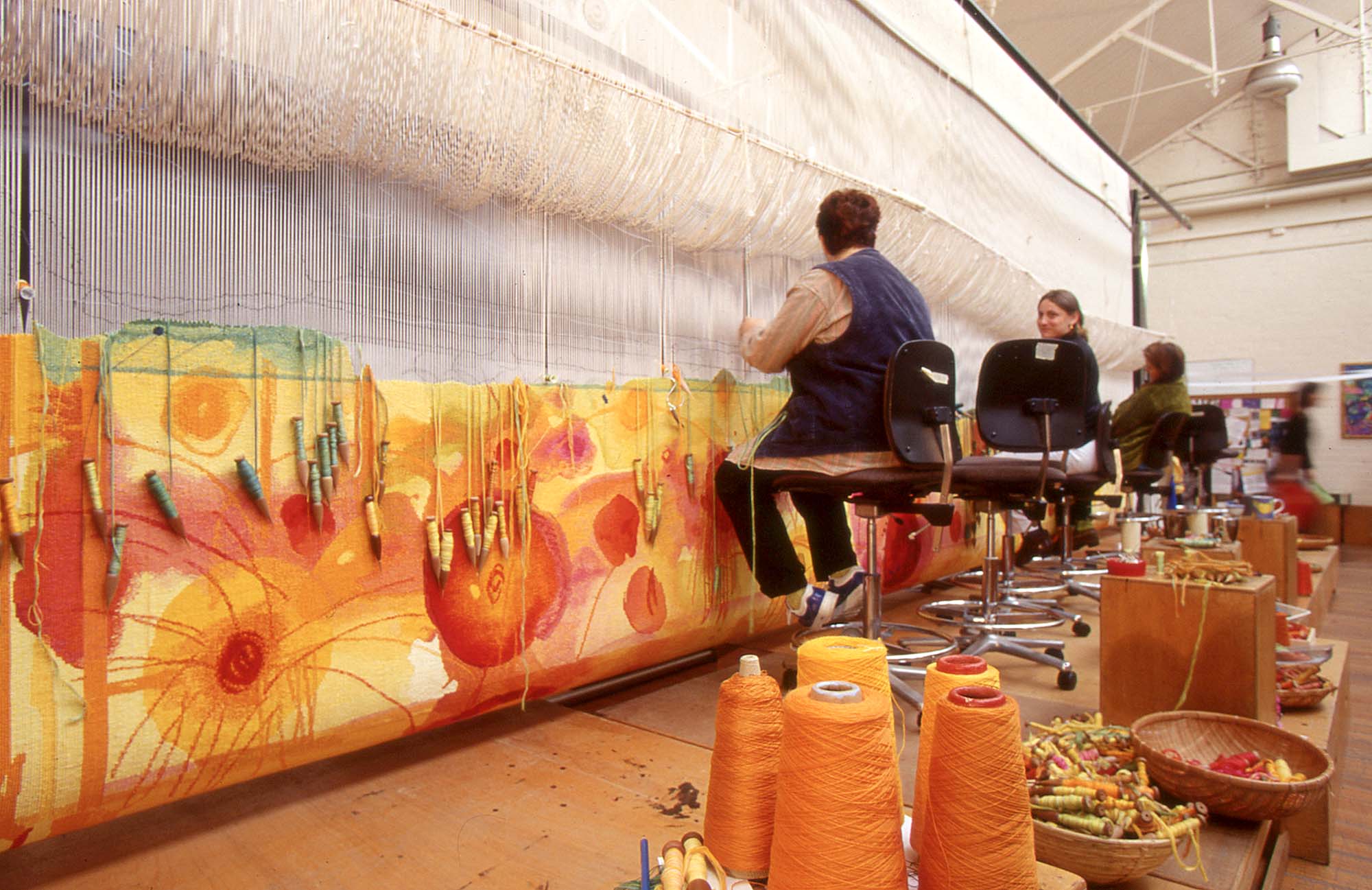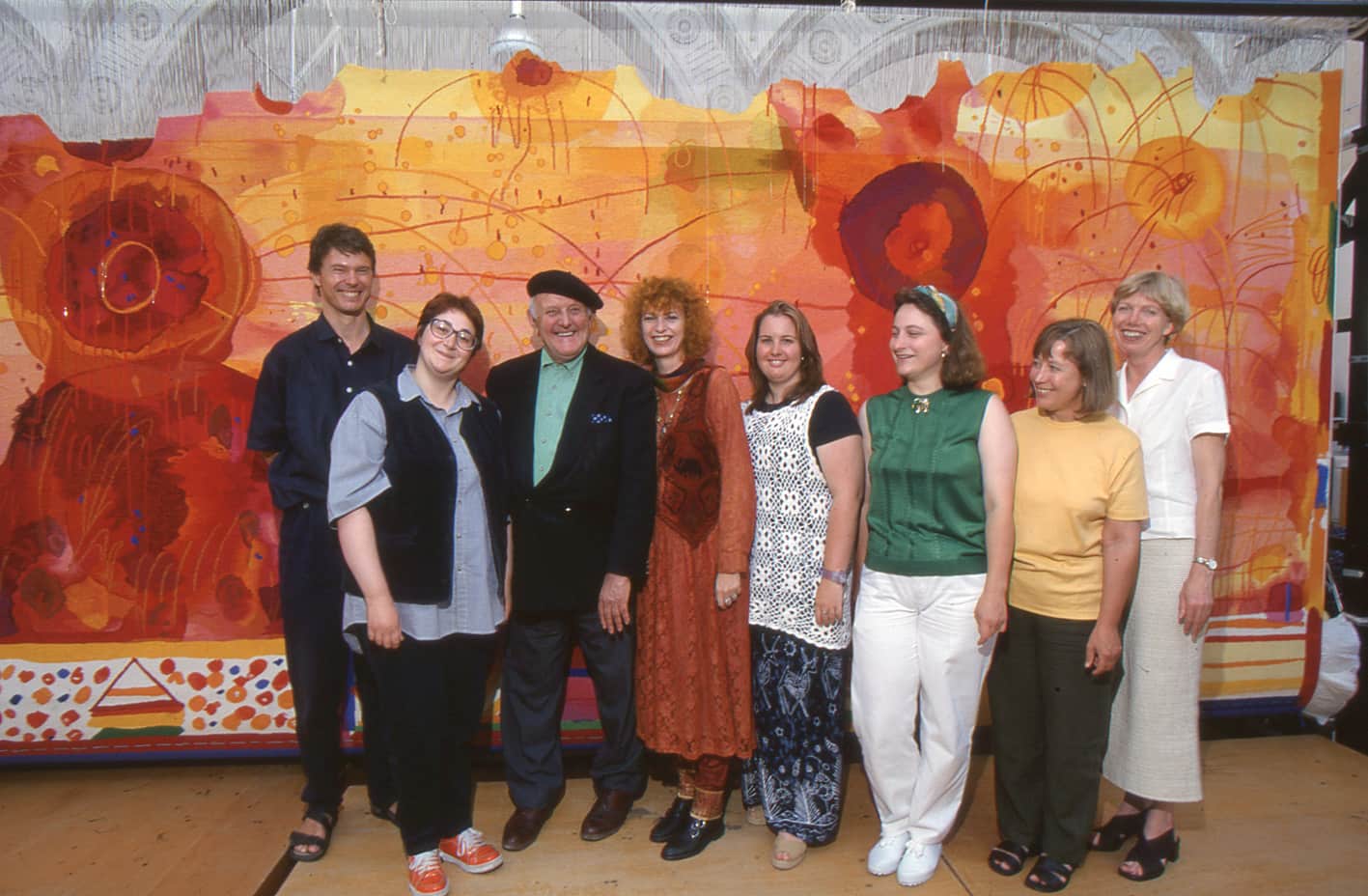
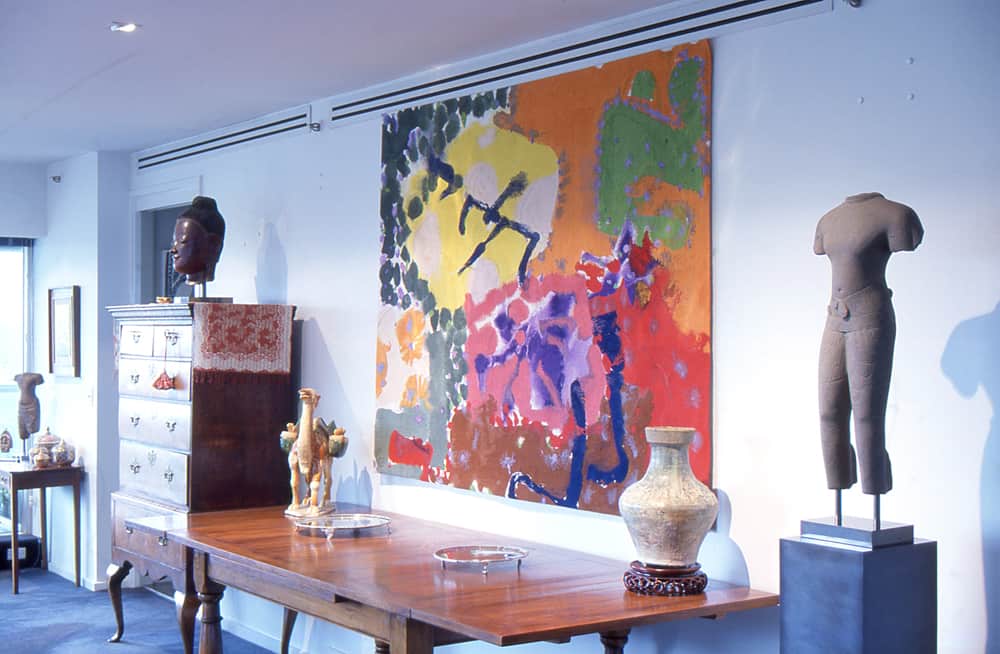
Prominent British artist Patrick Heron designed five tapestries after visiting Australia in 1990, the last of which, 22 July 1989, was woven at the ATW shortly after Heron’s death in 1999.
Heron (1920-1999) was a prominent figure in 20th-century British art associated with the St Ives School, based in Cornwall and led by Ben Nicholson and Barbara Hepworth.
Heron came to Australia in 1990 to undertake an artist residency at the Art Gallery of New South Wales, and was enthusiastic about the translation of his work into tapestry. In total five tapestries were woven by the ATW, all based on small gouaches Heron painted specifically for tapestry interpretation. Heron died just before the tapestry 22 July 1989 was completed in 1999.
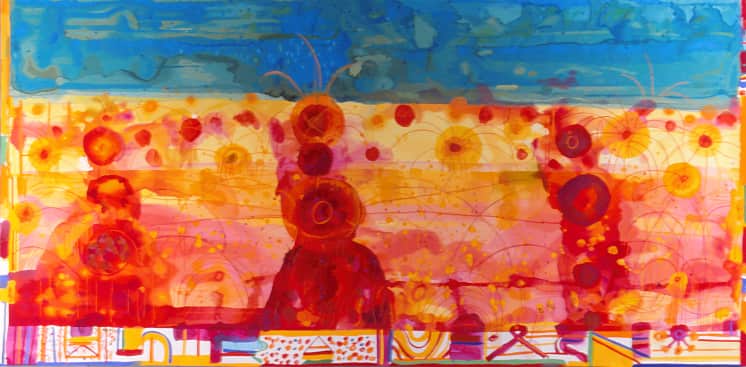
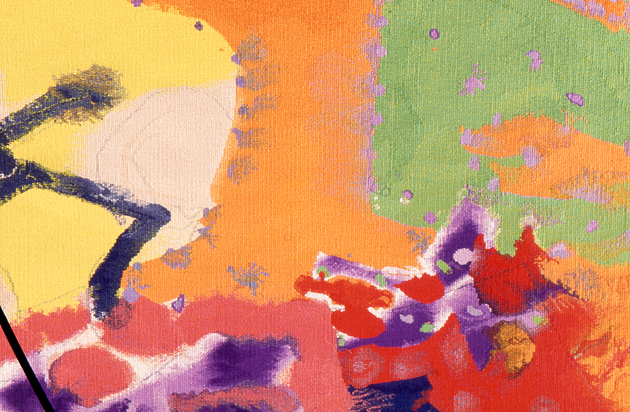
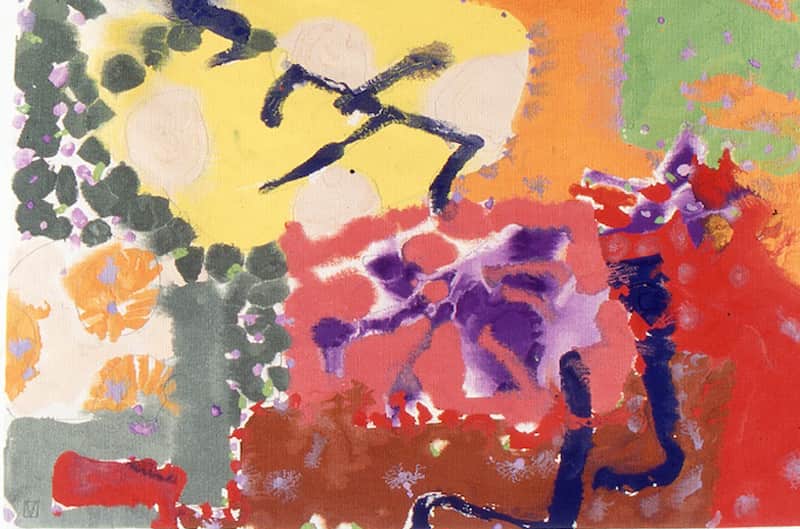
The design for 22 July 1989 was based on a small gouache painting created by Heron.
The original design has a fluidity of surface, derived from the material qualities of the water-based paint. Heron’s gouache works are often lightly executed, with loose, orbicular forms accenting the watery effects. In 22 July 1989 arabesques of vivid colours - orange, violet and viridian - suggest flowering shrubs like pimpernels and bell heather, native to the landscapes of Cornwall.
Heron relished the collaborative process of tapestry making, engaging in ongoing discussions revolving around colour, surface and scale. He delighted in the final outcome of tapestry production, making effusive statements as in a letter to the weavers of his first tapestry:
“I had never imagined you would be able to do something that was so subtle! It really is incredibly related to the gouache. In certain lights it is almost as if the water of the original was still moving about across its surface! I should love to do a number of other tapestries with you, now that I have seen what you are able to do.” [1]
Patrick Heron’s work has been collected by major public art institutions worldwide.
[1] Patrick Heron, letter to Anne Kemp and Barbara Mauro at the Victorian Tapestry Workshop, 18 December 1991, quoted in Artists' Tapestries From Australia 1976-2005, The Beagle Press, 2007, p.264.
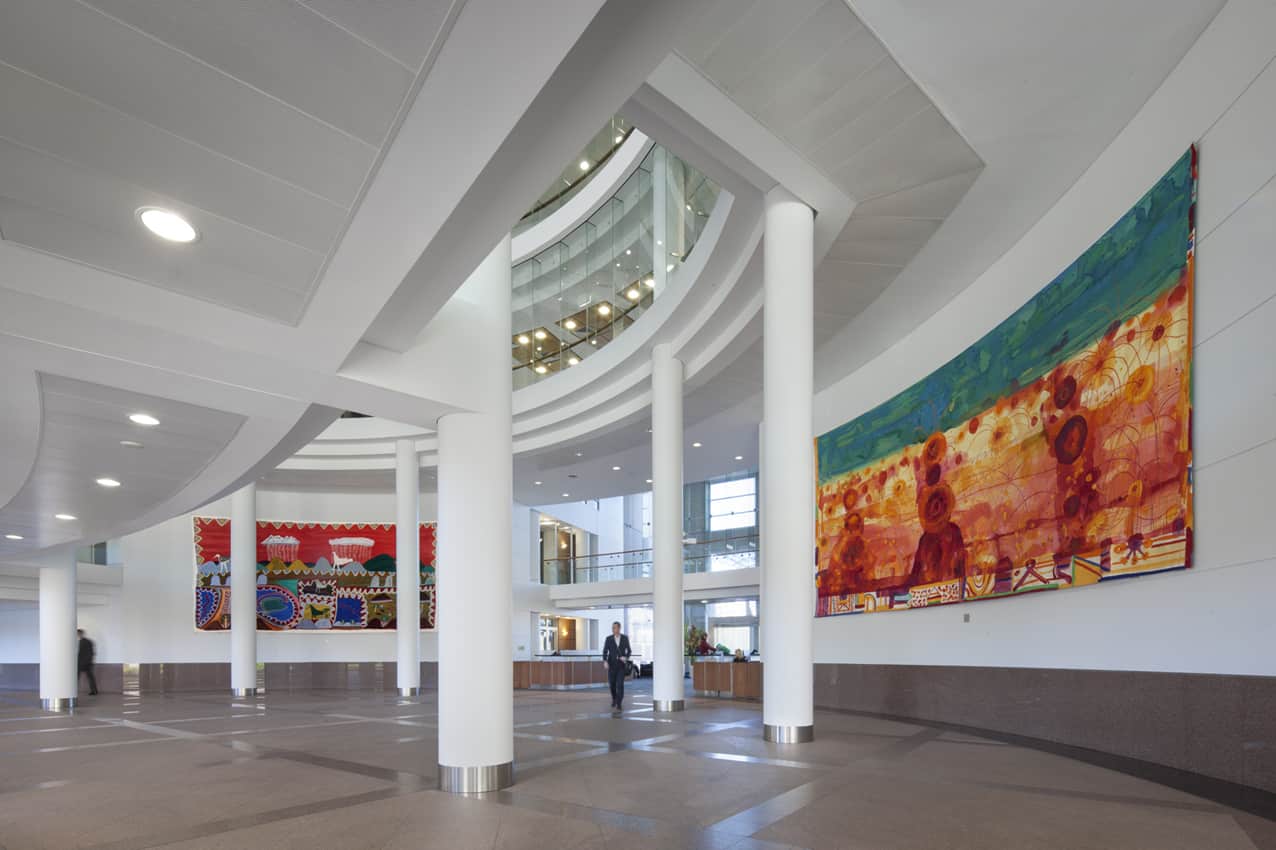
Rising suns over Australia Felix was the first of several tapestries designed by John Olsen AO OBE and woven by the ATW in 1997.
After working with tapestry workshops in France and Portugal in the 1960s, Olsen found the work of ATW weavers to be world-class and has been a steadfast supporter of the ATW ever since. Olsen is widely considered to be one of Australia’s most important living artists. He is known for his lyrical drawings and paintings that feature native Australian flora and fauna. His works are constructed with multiple meandering lines, energetic life-forms and the rich colours that make up the Australian landscape.
Rising suns over Australia Felix, commissioned by the Department of Foreign Affairs and Trade, was inspired on a return flight to Australia, at the exact moment when Olsen witnessed a sunrise and saw the ascending orb gradually illuminate the expansive land below. The scene is split into two distinct halves – sky and land – but in both realms the surface is dappled, suggesting the luminosity of the dawn scene. The monumental scale of the tapestry effectively conjures the vastness of the Australian continent.
Olsen’s work is housed in Olsen Gallery and has been collected widely by national and international institutions.
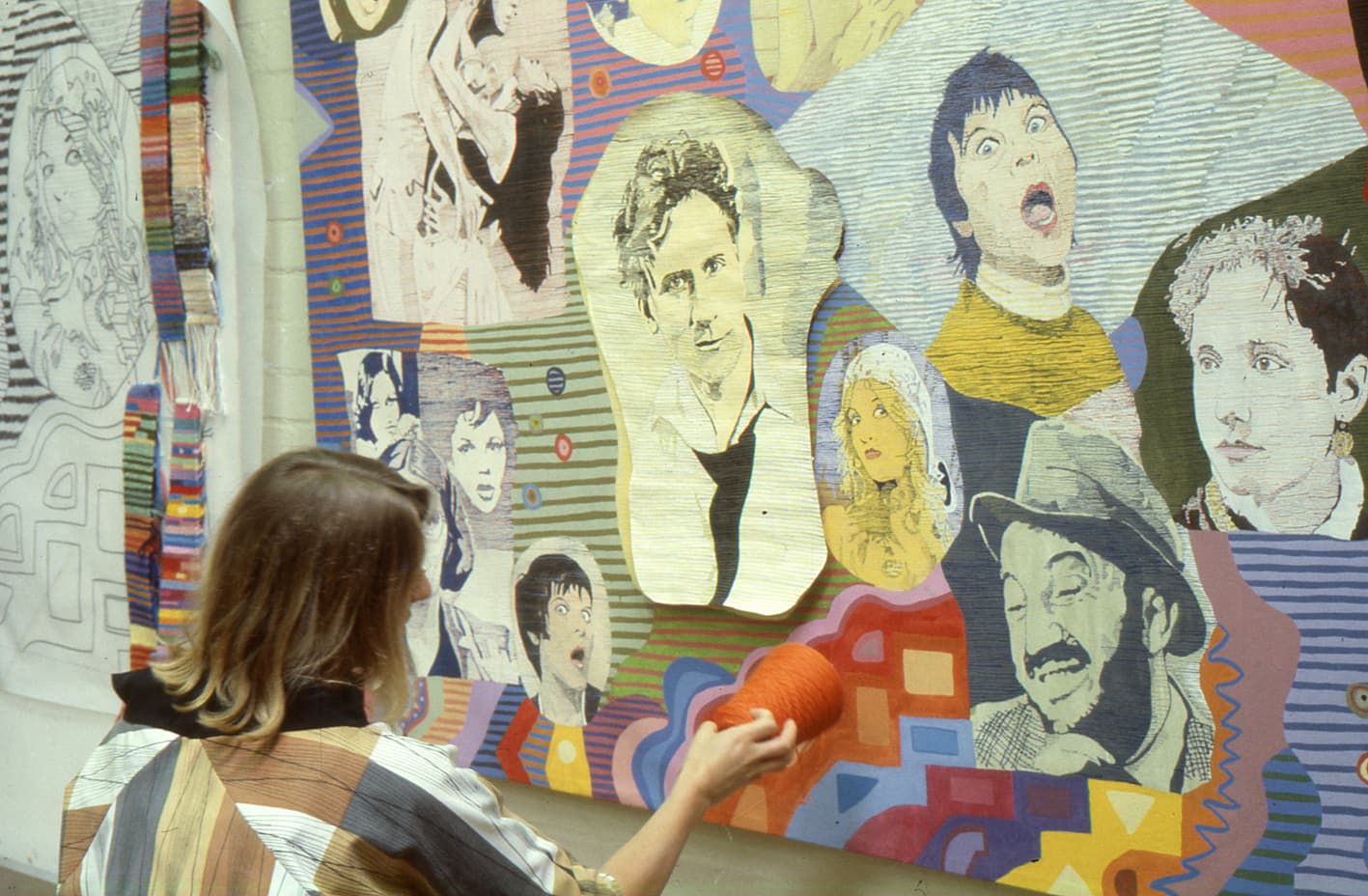
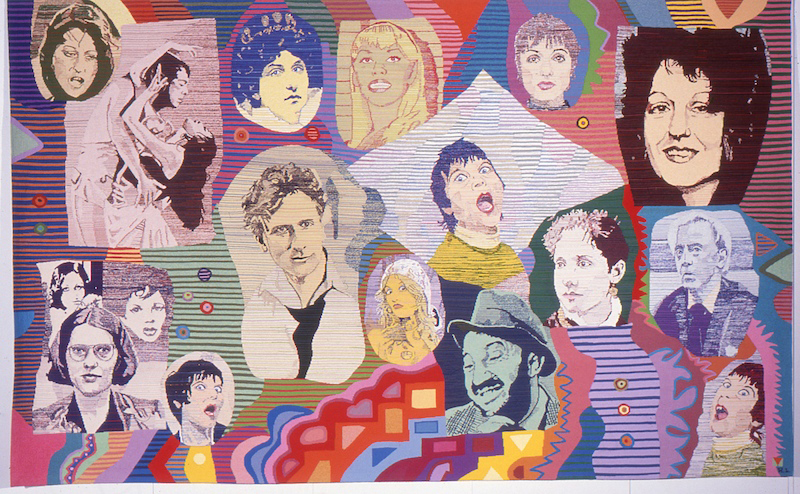
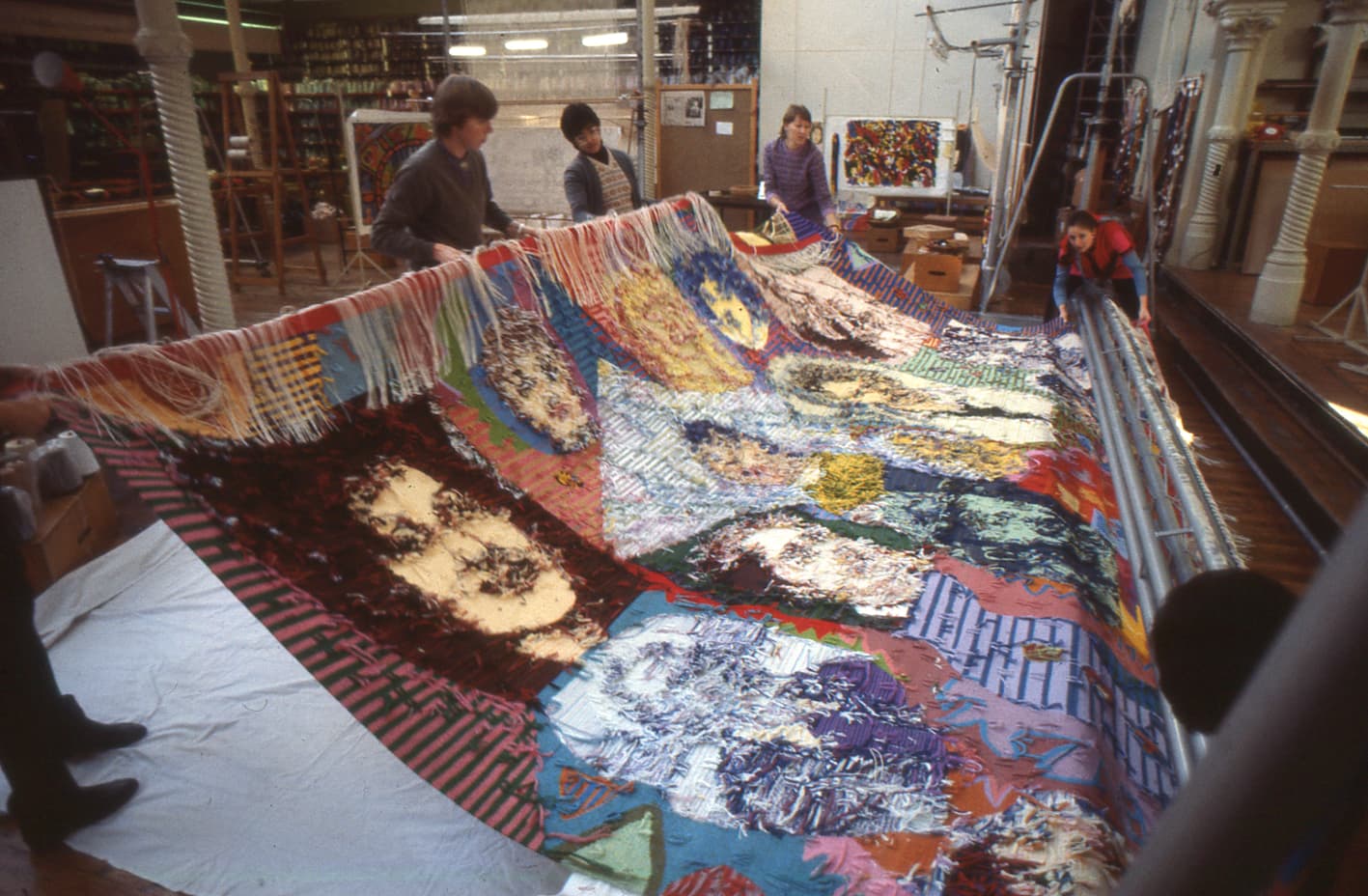
In 1982 four ATW weavers translated Pretty as - designed by prominent Australian artist Richard Larter - into tapestry.
Known for his use of bright colour and a collage-based approach to image production, Larter is classified as one of Australia's few highly recognizable pop artists.
Pretty as is housed in the National Gallery of Australia Collection in Canberra.
Larter has exhibited widely, both nationally and internationally, and is represented by Niagara Galleries, Melbourne.
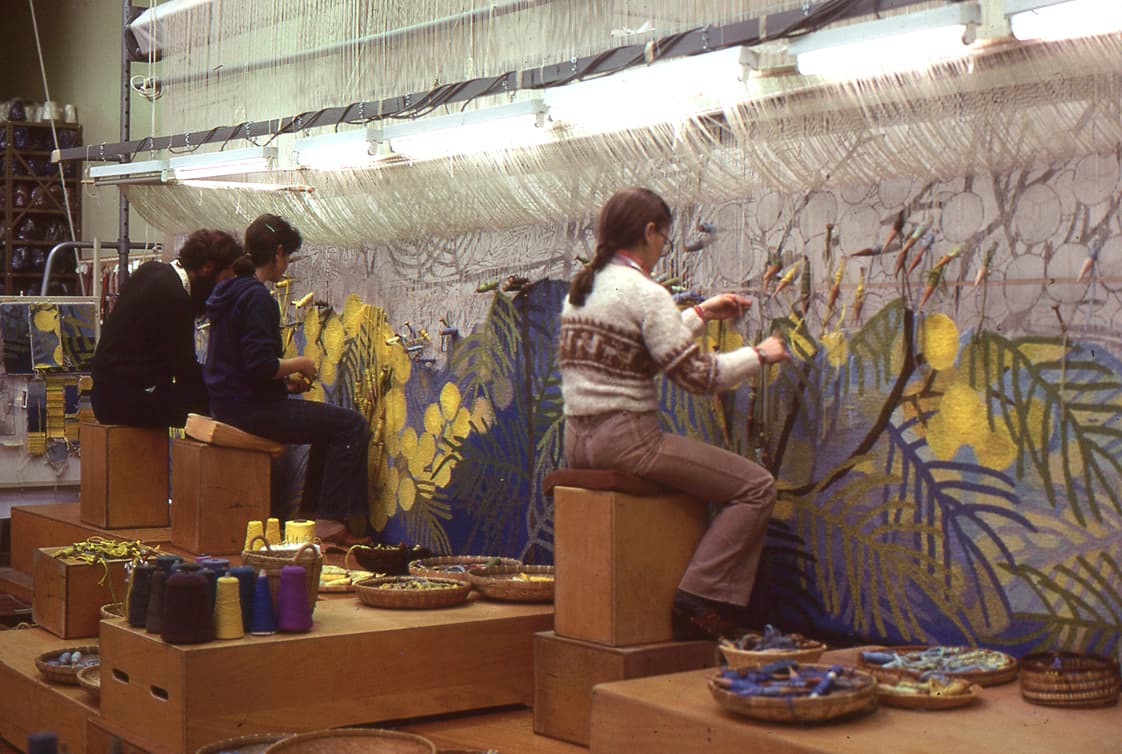
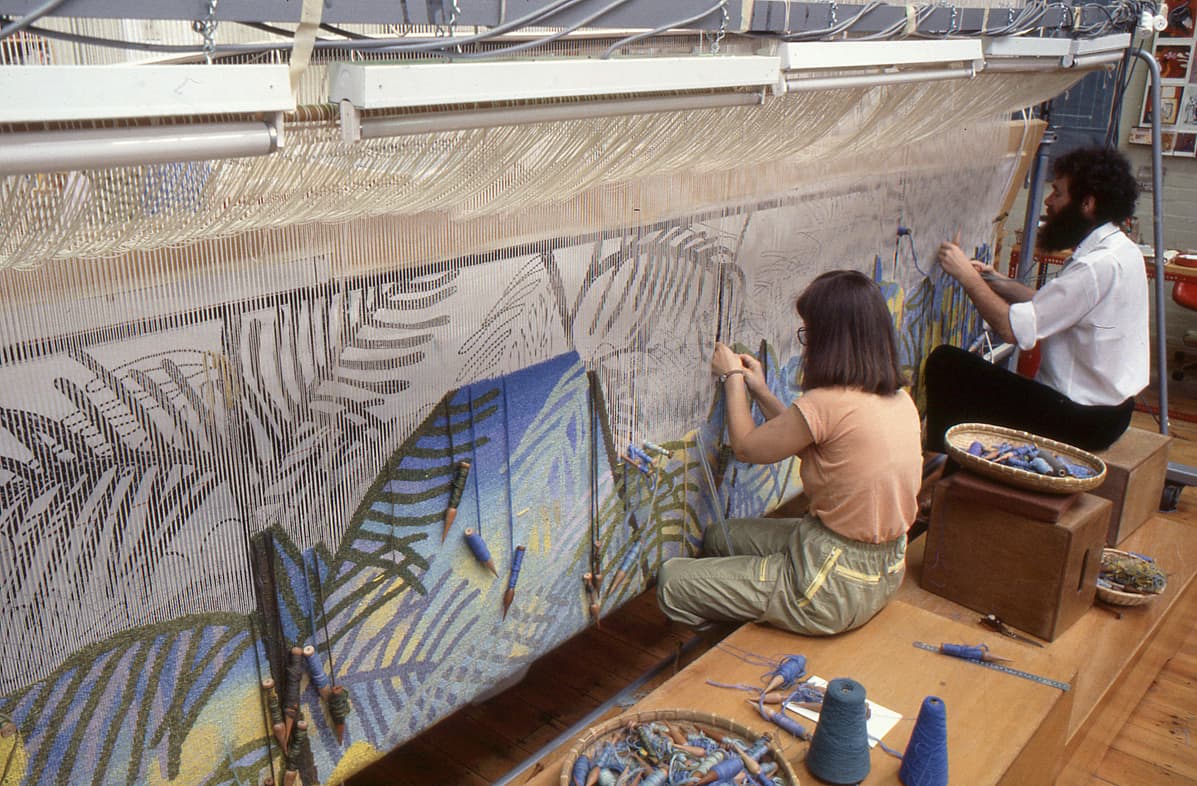
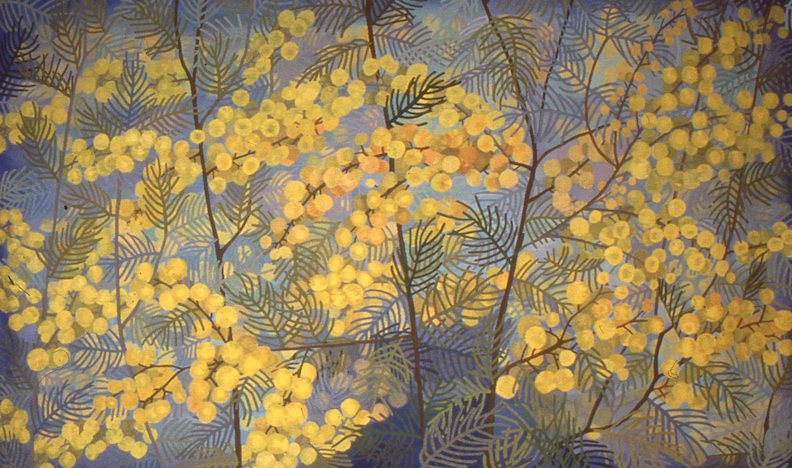
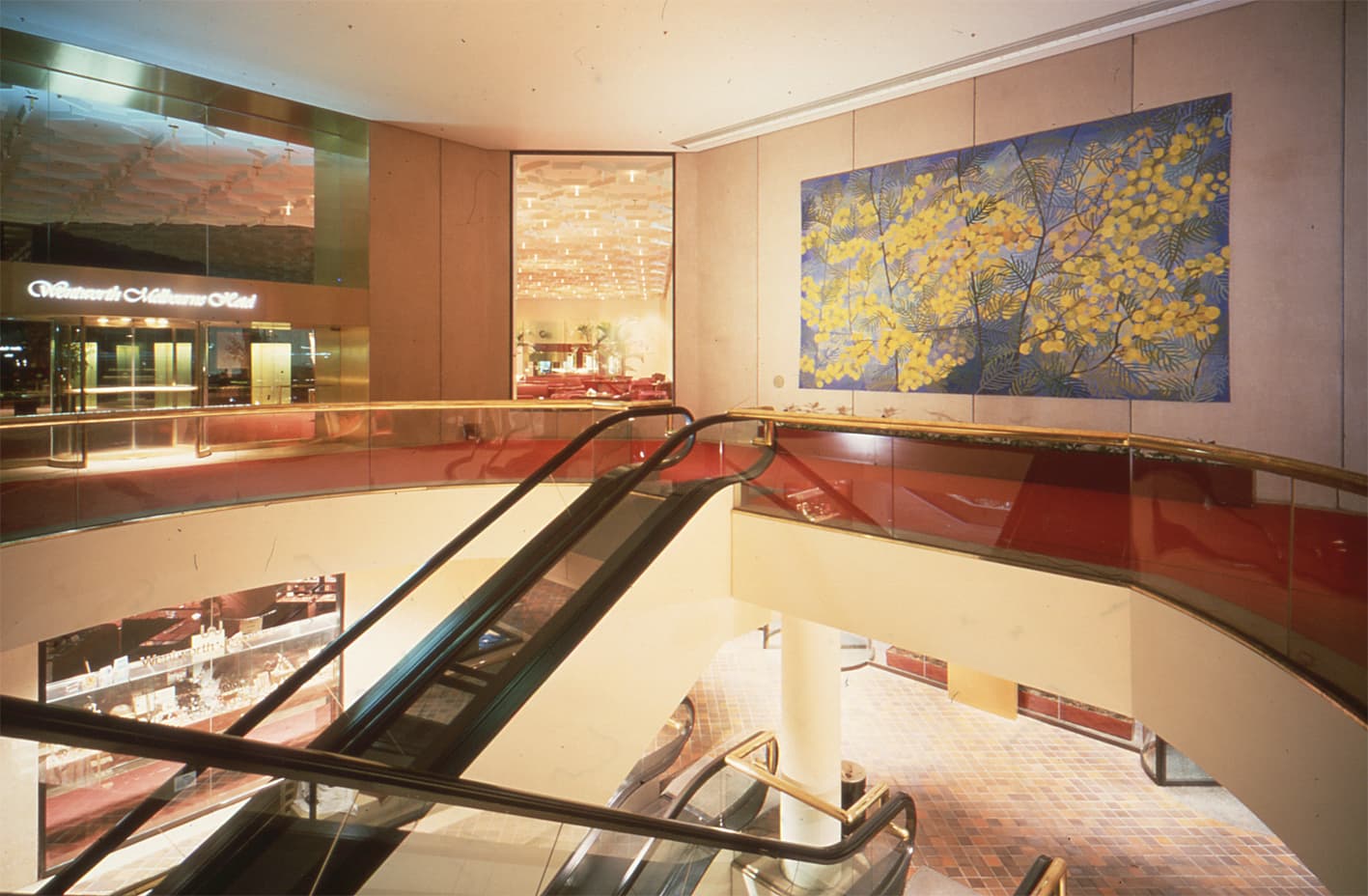
Marie Cook designed Wattle in 1979, as a companion piece to Pink Heath, woven in the same year for the Sofitel Hotel in Melbourne.
As oppose to Pink Heath, which was woven on it's side, Wattle was woven horizontally. This allowed more weavers to work on the project and facilitated the decision to purchase a new 8m loom for the Workshop.
Wattle and Pink Heath have remained popular depictions of Australian flora and are still much loved by Melbournians.